Tin Sculpting
INTERRED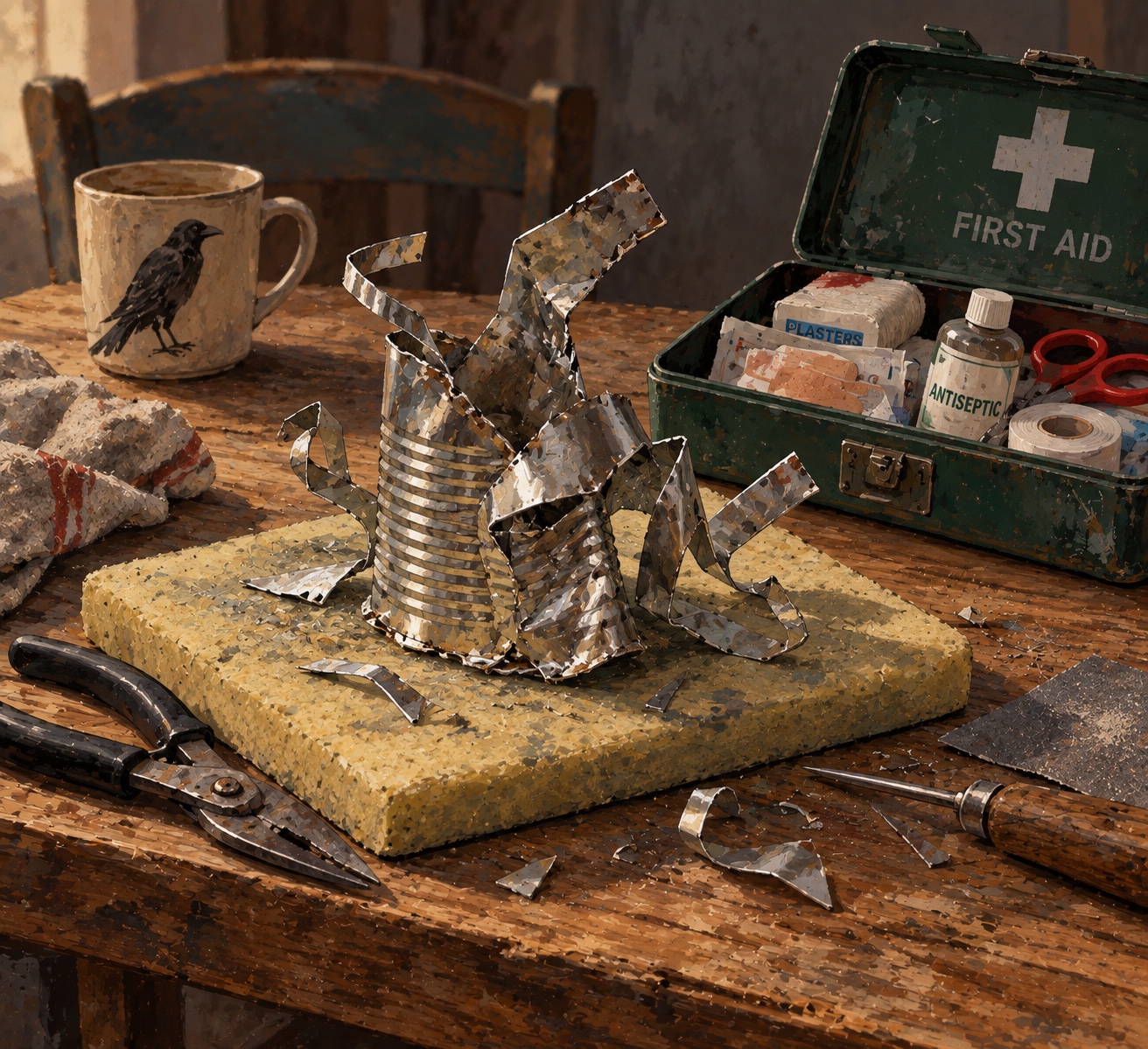
Date of Birth
02/09/2025
Date of Death
13/09/2025
It started, as these things so often do, with me watching someone on the internet doing something they were very good at.
Tin sculpting.
I can’t remember exactly what they were making, but I do remember thinking it looked brilliant.
More importantly, it looked doable.
This distinction has caused me problems before.
Within a remarkably short space of time, I had gone from that’s interesting to mentally embarking upon an exciting new career in metalwork.
I was going to make sculptures.
Beautiful sculptures.
Interesting, stylised sculptures made from discarded tin cans, thereby combining artistic expression with recycling and giving me the additional satisfaction of being insufferably pleased with myself about both.
I think the first one was going to be a crow.
Obviously.
So I started saving tins.
Beans eaten? Wash the tin.
Tomato soup? Keep the tin.
Something else emerging from a cylindrical metal container? Excellent. Raw materials.
Soon I had the beginnings of what I clearly imagined would become an artist’s stockpile.
There was, however, the small matter of equipment.
Apparently you can’t just take a baked bean tin and turn it into a crow through force of artistic intent.
I needed tools.
Tin snips were suggested.
I dismissed this almost immediately because I already owned an old pair of podiatry nail nippers.
Nail nippers cut hard things.
Tin snips cut hard things.
I could see no meaningful flaw in this reasoning.
Then I discovered I needed a ball-peen hammer.
I had no idea what a ball-peen hammer was.
After establishing that it was, in fact, a real hammer and not something somebody on YouTube had invented to make metalworking sound more complicated, I acquired one.
I also needed a foam pad.
Why?
Apparently because when you’re shaping metal, you need something underneath it that gives a little rather than a solid surface that fights back.
Fine.
Foam pad acquired.
By now I had tools, materials and ambition.
Quite a lot of ambition, actually.
At some point during all this, it was gently suggested to me that if I enjoyed working with metal I could eventually progress to other forms of metalwork, although anything more serious would require proper lessons and access to a workshop.
This was sensible advice.
I responded to it sensibly.
OH MY GOD YES. I COULD BE A BLACKSMITH.
Suddenly the bean tins were merely the beginning.
I would learn proper metalworking. I would have a forge. I would make magnificent metal sculptures while looking like some sort of medieval smithy.
And then another possibility occurred to me.
Swords.
If I got really good, I could make swords.
Proper swords.
Samurai swords and stuff.
This naturally led to an urgent need to Google metal folding.
I’d like to emphasise that at this point I had not yet successfully made anything out of a baked bean tin.
Nevertheless, in my head the career trajectory was now firmly established:
Bean tin → crow → metal sculptor → blacksmith → swordsmith.
All that remained was the relatively minor administrative detail of learning how to work with metal.
Then I selected a tin.
I cut it open.
The tin fought back.
Quite aggressively.
It turns out that the transformation from baked-bean container to beautiful stylised crow involves an intermediate stage in which the baked-bean container becomes a collection of extremely sharp pieces of metal with a personal grievance.
The nail nippers were not, perhaps, the revolutionary advance in metalworking technology I had anticipated.
I hammered things.
I bent things.
I attempted to shape things.
Nothing I produced bore any meaningful resemblance to a crow.
Or, as far as I can remember, anything else occurring naturally in the known universe.
Then I cut myself.
There comes a point in some creative endeavours when the artist must stand back from the work and ask what it is trying to say.
Mine was saying:
Fuck tin sculpting.
So I did.
The burgeoning collection of carefully washed tins went into the recycling.
My journey from baked beans to master swordsmith ended having produced approximately one mangled tin, some swearing and a minor injury.
The ball-peen hammer survived.
It turns out hammers are useful even when you’ve abandoned the artistic movement for which you purchased them.
The foam pad survived too. It eventually found employment as a kneeling pad and later as protection for my laptop when travelling.
So the project itself was an almost complete failure.
But unlike the crow, which never made it out of the bean tin, at least some of the equipment went on to have a meaningful life.
Cause of death: Hostile raw materials.
Legacy: One useful hammer, one surprisingly versatile piece of foam, and a promising career in Japanese swordsmithing cut tragically short before it began.